


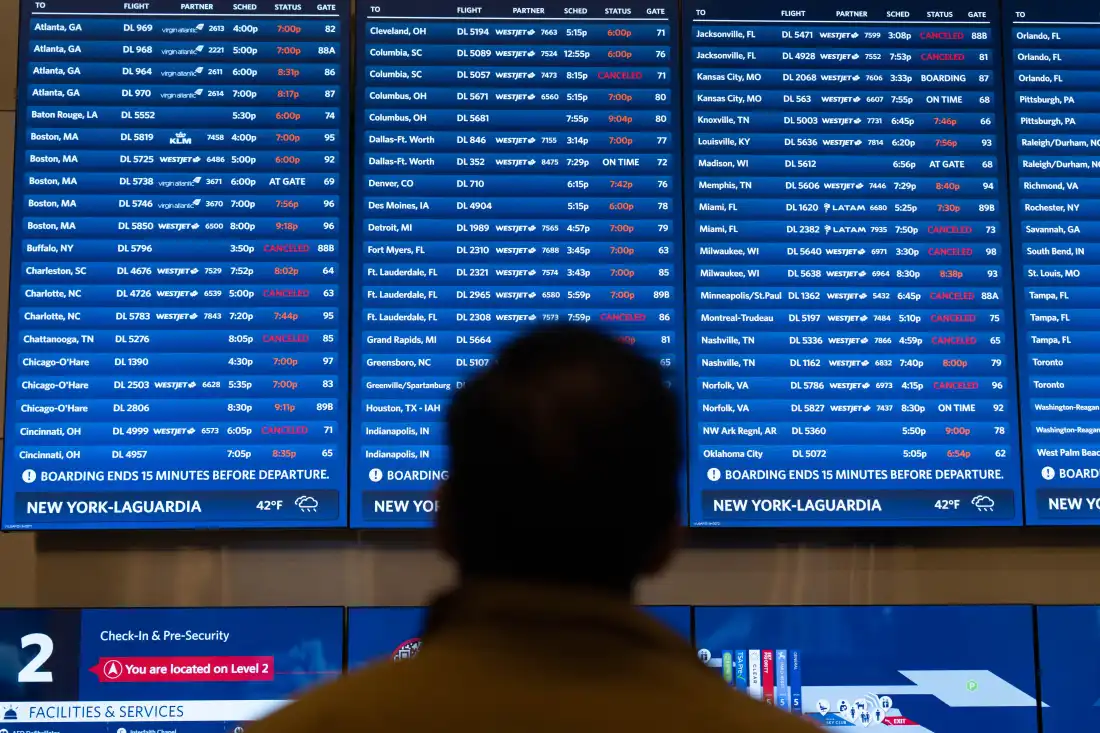
Transportation Secretary Sean Duffy has identified a telecommunications upgrade performed by federal contractor L3Harris as the likely trigger behind Friday’s extraordinary nationwide air traffic ground stop, revealing how a malfunction involving aging infrastructure disrupted thousands of flights across the United States.

The November 13 shutdown brought departures at airports nationwide to a halt for nearly five hours, creating one of the most significant disruptions to American air travel in recent years.
Duffy provided additional details during a November 14 briefing alongside Federal Aviation Administration Administrator Bryan Bedford, explaining how a routine maintenance operation led to widespread communications problems.
The incident began as a contractor attempted to replace outdated copper telecommunications connections with modern fiber-optic technology at a remote FAA facility.
L3Harris, a major defense and communications contractor, has operated the FAA’s legacy telecommunications network for more than two decades.
The company was carrying out work intended to move the network away from older analog technology and toward a digital communications system.
According to Duffy, the upgrade involved replacing infrastructure that had become so outdated that the existing copper service was being discontinued.

The maintenance operation should have been a relatively straightforward modernization task, but a serious technical malfunction caused unexpected consequences throughout the air traffic control network.
The problem involved a router associated with the transition from copper-based communications to fiber-optic connections.
Duffy explained that the equipment began sending excessive connection requests to other routers within the FAA system.
The malfunction generated more than 1,000 connection attempts every four to five seconds, overwhelming parts of the network.
The resulting data traffic created instability in communications used by air traffic controllers and affected radar information at FAA facilities.
The disruptions spread across a substantial portion of the national system, affecting 17 of the FAA’s 22 en route air traffic control centers.
The scale of the malfunction made it difficult for officials to immediately determine whether the entire system could continue operating safely.
Faced with unreliable communications and radar feeds, federal aviation authorities issued a nationwide ground stop.
The decision halted departing flights while air traffic controllers worked to manage aircraft already in the air.
Duffy emphasized that protecting passengers and flight crews was the government’s overriding responsibility during the emergency.
“Your safety is paramount,” the secretary declared while explaining why the FAA suspended departures.
The shutdown placed enormous pressure on airlines, airports, pilots, controllers, and passengers throughout the country.
Approximately 3,500 aircraft were already airborne when the disruption occurred, requiring air traffic personnel to coordinate their safe arrival while preventing additional departures.
Duffy praised the work of controllers and pilots who maintained flight safety despite the communications problems.
The Transportation Department reported that the affected aircraft were brought down safely and that thousands of flights resumed after officials restored the system.
The FAA began reopening American airspace at approximately 8:15 p.m. Eastern Time on Friday.
Before allowing normal operations to resume, officials tested the affected systems to confirm that communications and other essential functions had stabilized.
The ground stop was lifted, but the consequences continued affecting airline schedules as carriers attempted to reposition aircraft and flight crews.
More than 10,000 flight delays and over 4,000 cancellations were reported Friday, creating disruptions at airports across the nation.
